Treat yourself to $500+ in MVJewels and enjoy FREE INTERNATIONAL SHIPPING.


Larimar: A Dominican Stone, a Living Expression of Identity and Its Story in Contemporary Jewelry

Some materials speak of a place before anyone explains where they come from. Larimar is one of them.
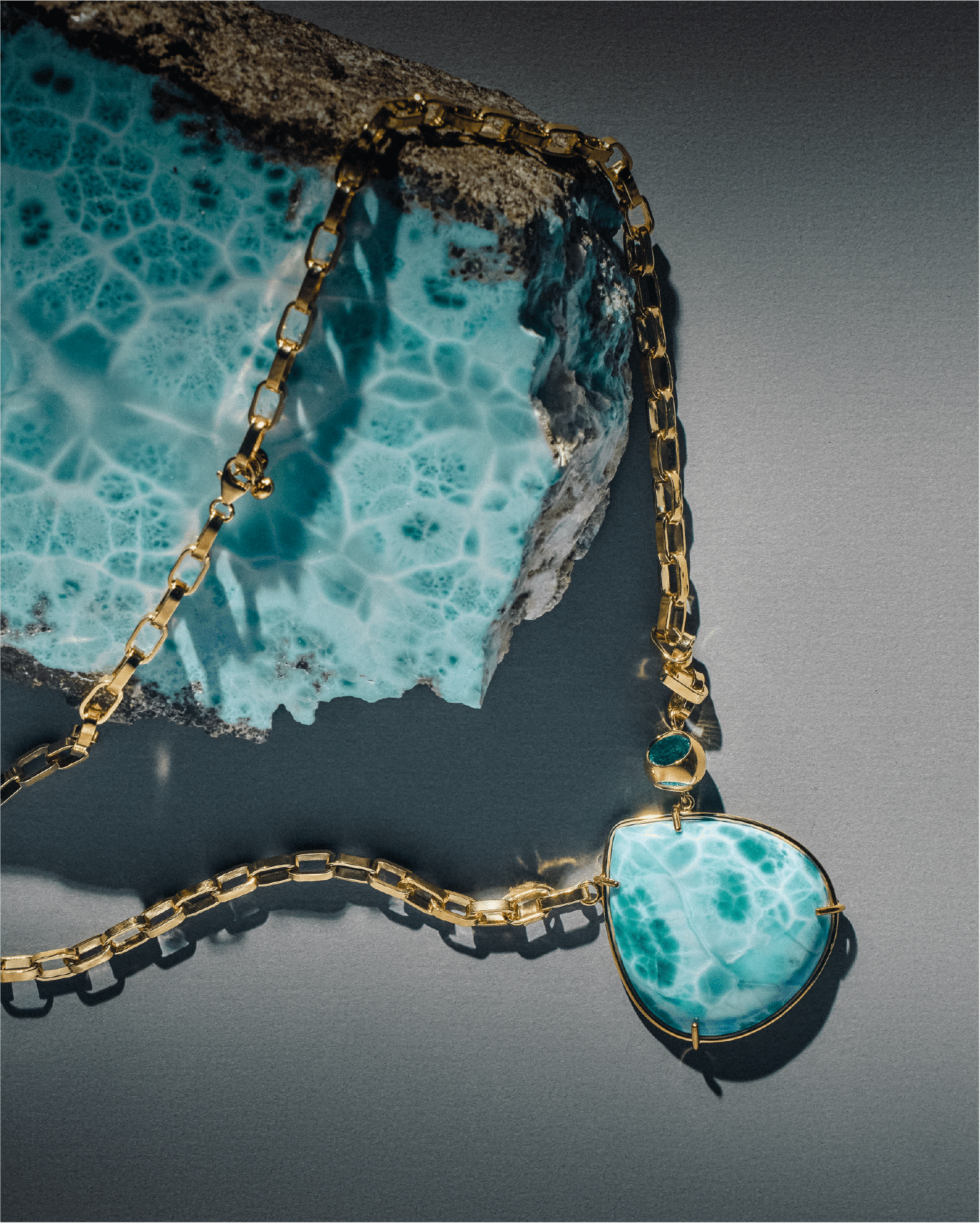
Found only in one region of the Dominican Republic, Larimar carries the colors, contrasts, and creative spirit of the island that formed it. Its shifting blues recall shallow Caribbean waters, open skies, and sunlight moving across the sea. For Mónica Varela, working with this singular stone is both an artistic choice and a commitment to honoring its origin. Her creative journey is rooted in a desire to reveal the natural treasures of the Dominican Republic through contemporary design, and Larimar sits at the heart of that mission.
She does not approach it as a familiar stone to simply place in a setting. She reads it first, studying where the color runs deepest, how the veining moves, and which face holds the most life, before she decides what the stone can become. The stone begins the conversation. The design answers it, never the other way around.
What Is Larimar and Where Does It Come From?
Larimar is a rare blue variety of pectolite found only in southwestern Dominican Republic, in the Sierra de Bahoruco, province of Barahona. No other source of this blue pectolite has been documented anywhere in the world, which makes Larimar one of the few gemstones tied entirely to a single origin.
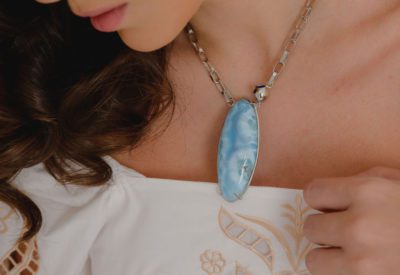
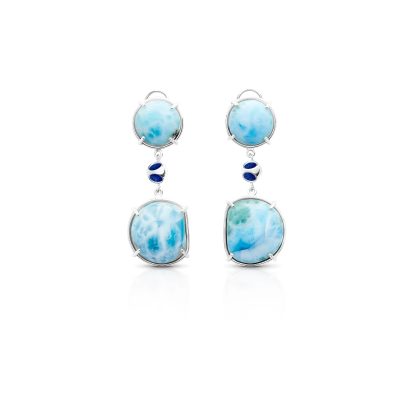
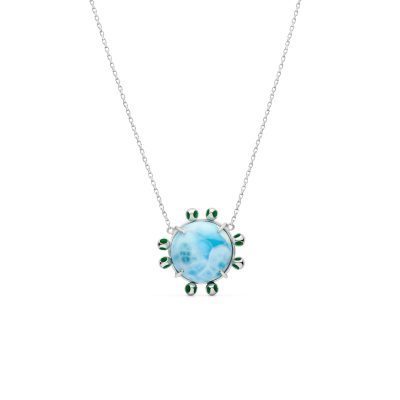
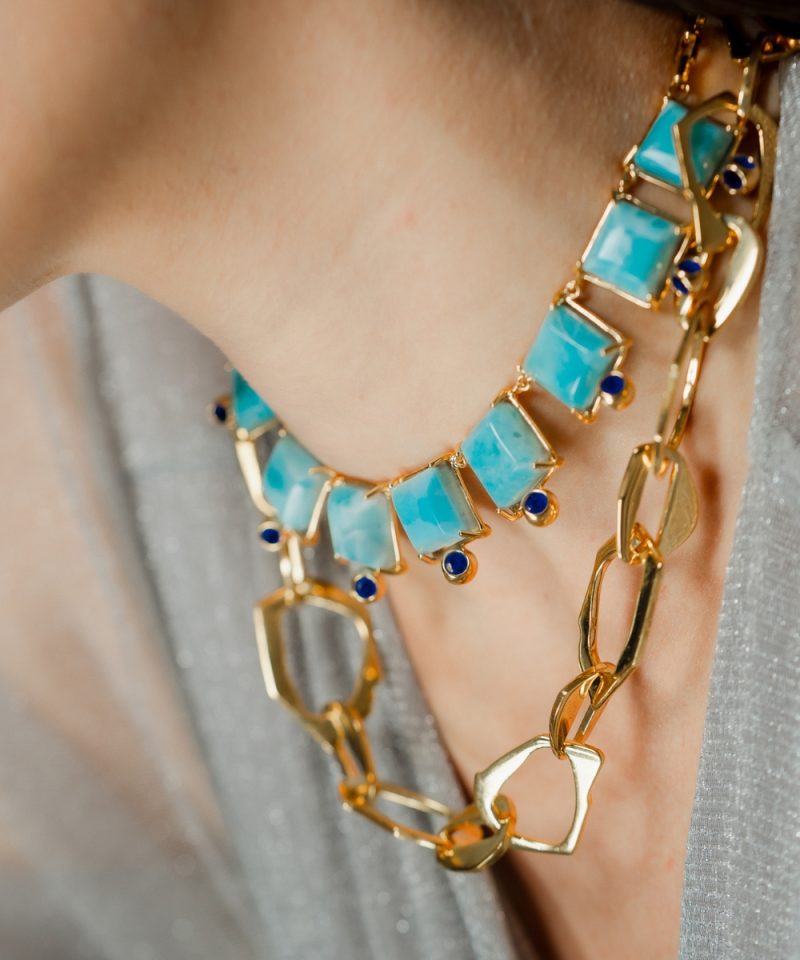
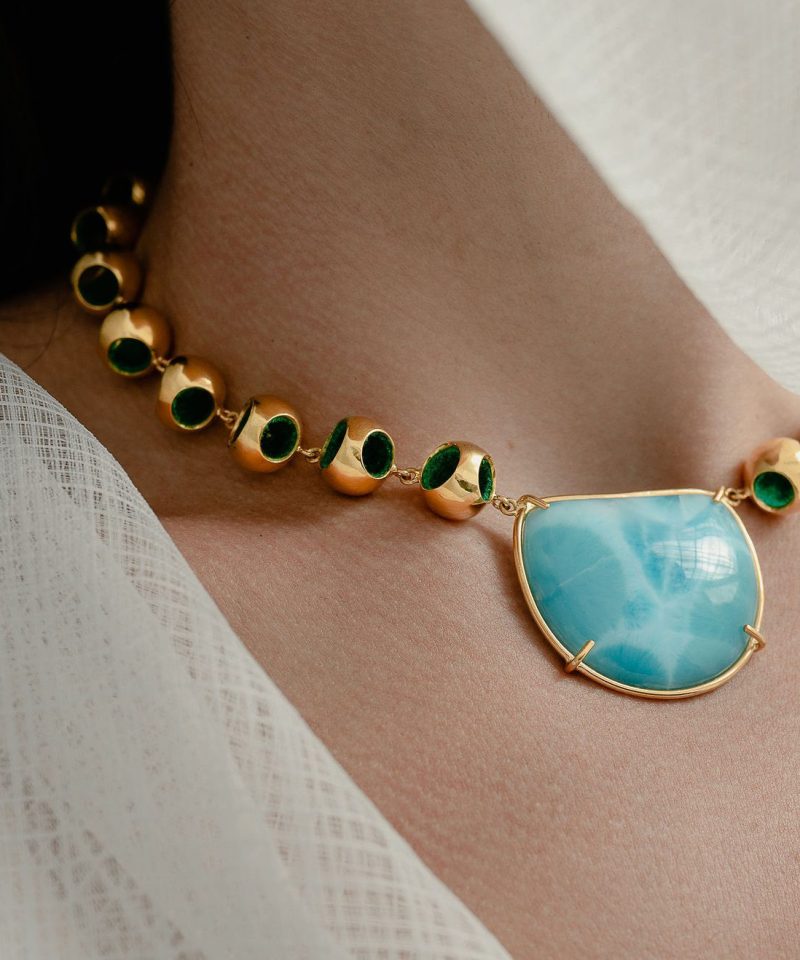
No two pieces look exactly alike. Some reveal pale, cloudlike patterns. Others move through turquoise, green-blue, and deeper ocean tones, with white veining crossing the surface like foam seen from above. These variations are the stone’s natural signature, and because no two formations repeat, no two cuts can either. The stone in a finished jewel is not one of a series. It is the only one of itself the Earth ever made.

The History Behind the Name
Larimar’s story reaches back further than most people realize. In 1916, Father Miguel Domingo Fuertes reported the presence of a blue-green stone found along the Bahoruco River, decades before the world understood what it was. For generations, it remained something glimpsed and mentioned rather than named and studied.
That changed in 1974, when artisan Miguel Méndez and geologist Norman Rilling rediscovered the stone and helped identify it as a blue pectolite unlike anything documented elsewhere. Méndez also gave it its name, joining Larissa, his daughter’s name, with mar, the Spanish word for sea. There is a quiet irony in that choice: Larimar is named for the sea it resembles, yet it formed in the mountains, an inland stone baptized after the ocean by a father honoring his daughter.
A Symbol of Dominican Identity
Larimar has become one of the most recognizable expressions of Dominican material culture. Its value reaches beyond rarity. It represents a direct relationship between land, craftsmanship, and national identity, carrying the island’s volcanic history alongside the people who mine, select, cut, polish, and transform it.
A finished jewel can look effortless, yet it holds many stages of knowledge. Local miners understand the terrain. Lapidaries reveal the strongest color and most expressive pattern in the raw material. Artisans bring precision to every cut, surface, and setting. That human dimension is precisely what drew Mónica to the stone. For a Dominican jewelry artist, Larimar is not simply a beautiful material. It is a way of telling her country’s story through her own hands.




What Is the Meaning Behind Larimar?
People often associate Larimar with serenity, emotional clarity, and calm expression. Within spiritual traditions, its blue tones are believed to encourage harmony, ease fear, and support heartfelt communication.
The stone has gathered older, stranger stories too. Legend calls Larimar the elixir of Atlantis: an ancient liquid, the myth goes, that turned solid the moment it touched air, and that Atlanteans drank to speak with their gods. It is folklore, not history, but it says something true about the stone. People have always looked at Larimar and sensed that it belongs to a world slightly beyond this one.
In the Monica Varela universe, jewelry holds energy, stories, and individuality, and Larimar tends to gather all three. One wearer may connect it to home. Another may see freedom, calm, or the confidence to speak openly. The stone carries its origin. The person who wears it gives it a new story.
Beyond the Postcard Caribbean
People often reach for the Caribbean when they describe Larimar, and the color naturally invites that association. But limiting the stone to a souvenir overlooks what it can do in the hands of a designer.
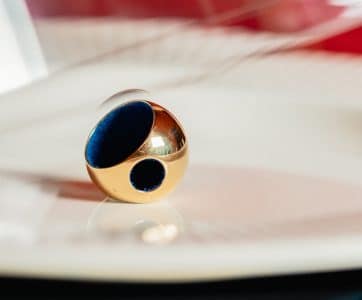
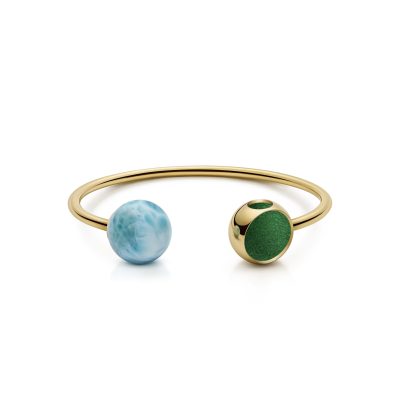
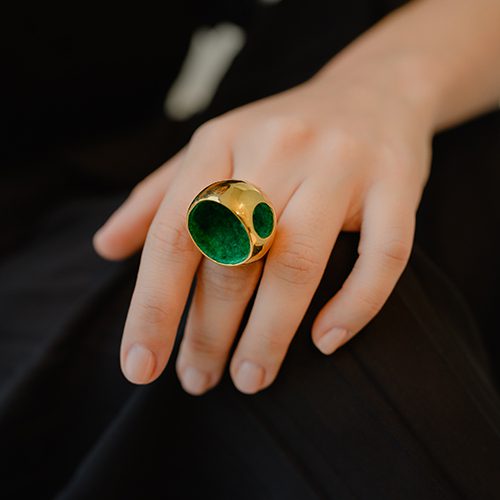
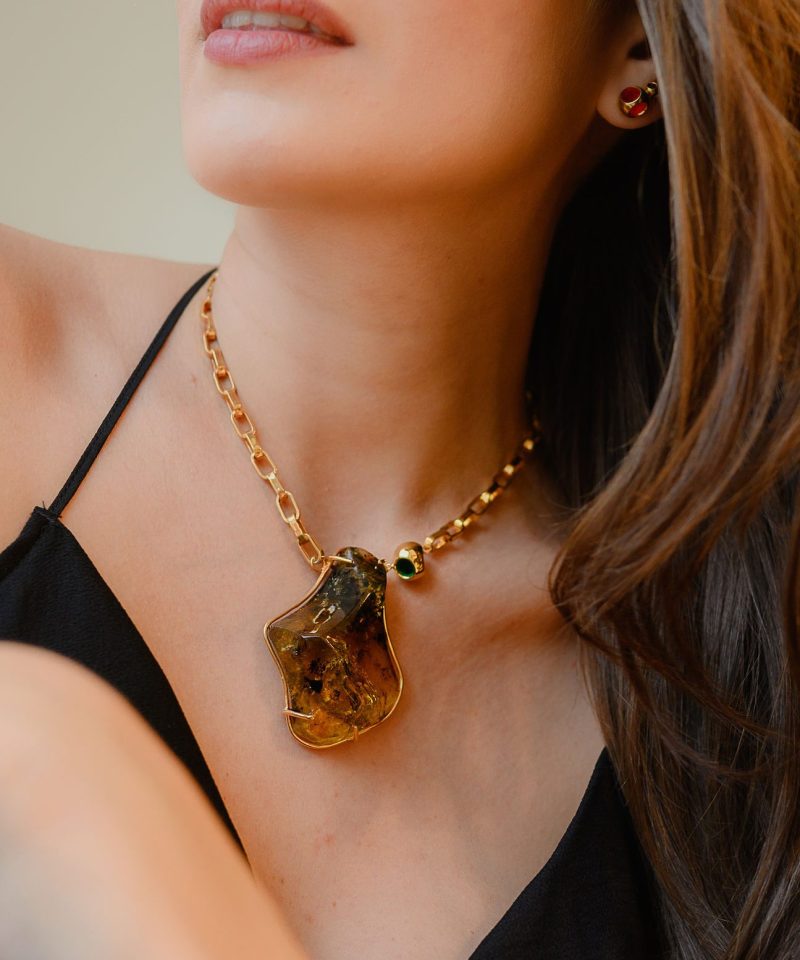
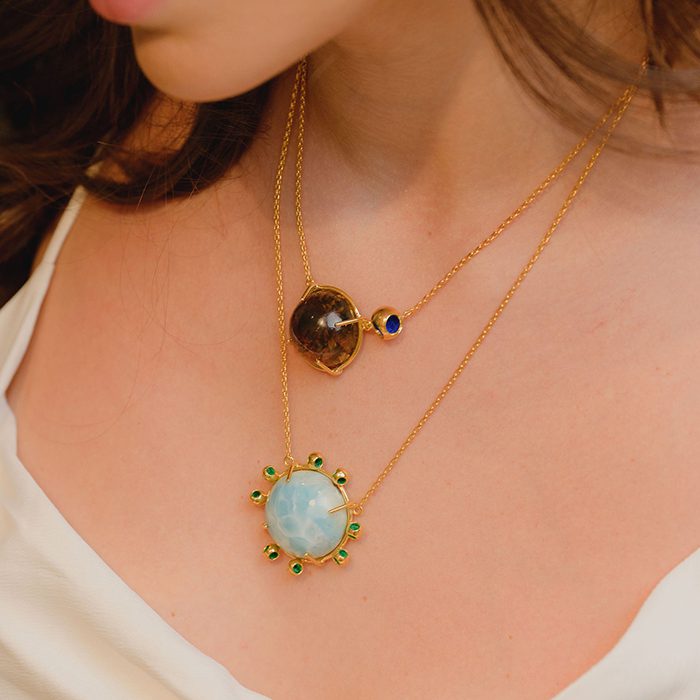
Mónica treats Larimar as a material for contemporary jewelry, not a symbol to illustrate. Her work explores how the stone’s organic patterns interact with sculptural volumes, abstract lines, and recognizable design codes such as the Huritá sphere, letting Larimar enter forms that owe nothing to postcards of the Caribbean, yet everything to the island itself. Origin does not confine the design. Origin gives it meaning. And because every Larimar carries a pattern that exists nowhere else, every finished piece becomes a collaboration between the Earth’s one attempt at that stone and the designer’s one answer to it.
A Protected Origin that Values Good Practices
The Dominican Republic granted its own Denomination of Origin protection to Larimar Barahona in 2018, and in 2025 the designation received international registration through the World Intellectual Property Organization under the Lisbon System. Mónica Varela is the first three-dimensional registered trademark brand to receive the certificate of origin for Larimar Barahona, an honor awarded by the regulatory council led by the Ministry of Energy and Mines and ONAPI during National Larimar Day, attesting that the Larimar in her pieces is authentic, traceable, and sourced from its protected Dominican origin.
She has described receiving it as one of the most meaningful moments of her career, a recognition of the value of Larimar and of the Dominican Republic itself, its identity, and its mineral legacy. That recognition extends a responsibility she has carried for years: close relationships with local miners, lapidaries, and artisans who understand the material and share her commitment to responsible practices, shaping how each piece comes together long before it reaches a workbench.
From Dominican Earth to a Wider World
Larimar offers an immediately compelling color, but its deeper power sits in everything that color contains: the geology of Barahona, the knowledge of miners and artisans, and a Caribbean design language that keeps evolving. For Mónica Varela, bringing Larimar into contemporary jewelry is a way of revealing the Dominican Republic through its own materials, and through the hands that know them best.
Every piece of Larimar is singular. So is the connection each person forms with it. Worn close to the body, intentionally set with an open back so the stone touches skin directly, it becomes more than a reflection of the Caribbean. It becomes a reminder that belonging can be carried, transformed, and made entirely your own.